LLM-AutoSciLab models scientific discovery as active hypothesis-conditioned experiment design — iteratively generating hypotheses, selecting maximally informative experiments, and refining mechanisms using observed evidence.
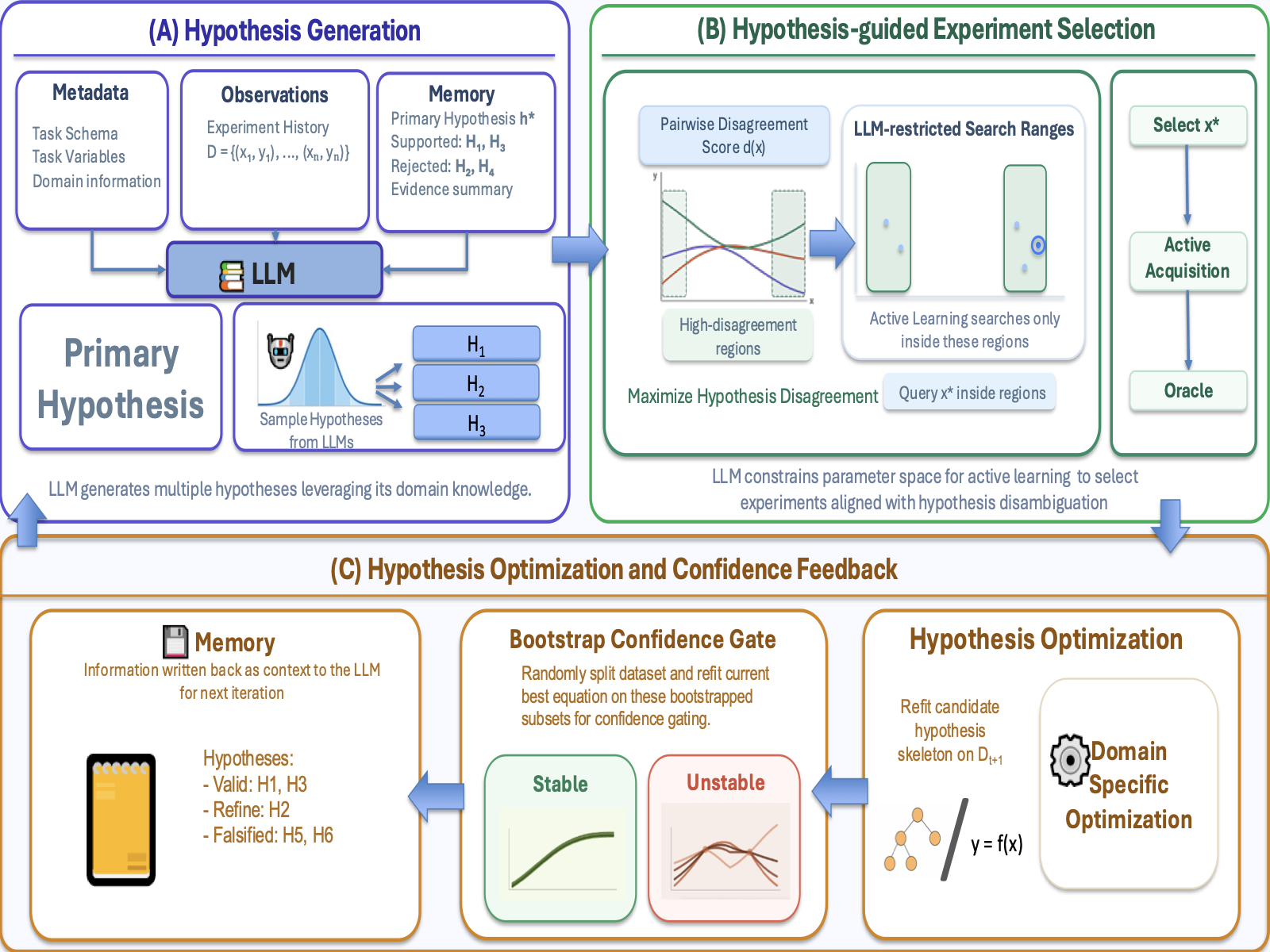
Figure 1. Overview of LLM-AutoSciLab. (A) An LLM generates candidate hypotheses from observations and memory. (B) Experiments are selected in regions of maximal hypothesis disagreement. (C) Candidates are refined via domain-specific optimization, with a bootstrap confidence gate filtering brittle hypotheses.
A smaller LLM generates diverse candidate hypotheses conditioned on accumulated observations and memory. A larger LLM synthesizes these into a structured primary hypothesis, alternatives, and diagnostic search regions — without premature collapse.
Acquisition targets regions of maximal disagreement among competing hypotheses. In Disambiguate mode, experiments separate competing mechanisms; in Refine mode, they improve parameterization of a stable candidate.
Each hypothesis is refit on the augmented dataset. A bootstrap confidence gate filters unstable candidates. The refined mechanism is written back to memory, informing subsequent hypothesis generation and acquisition.
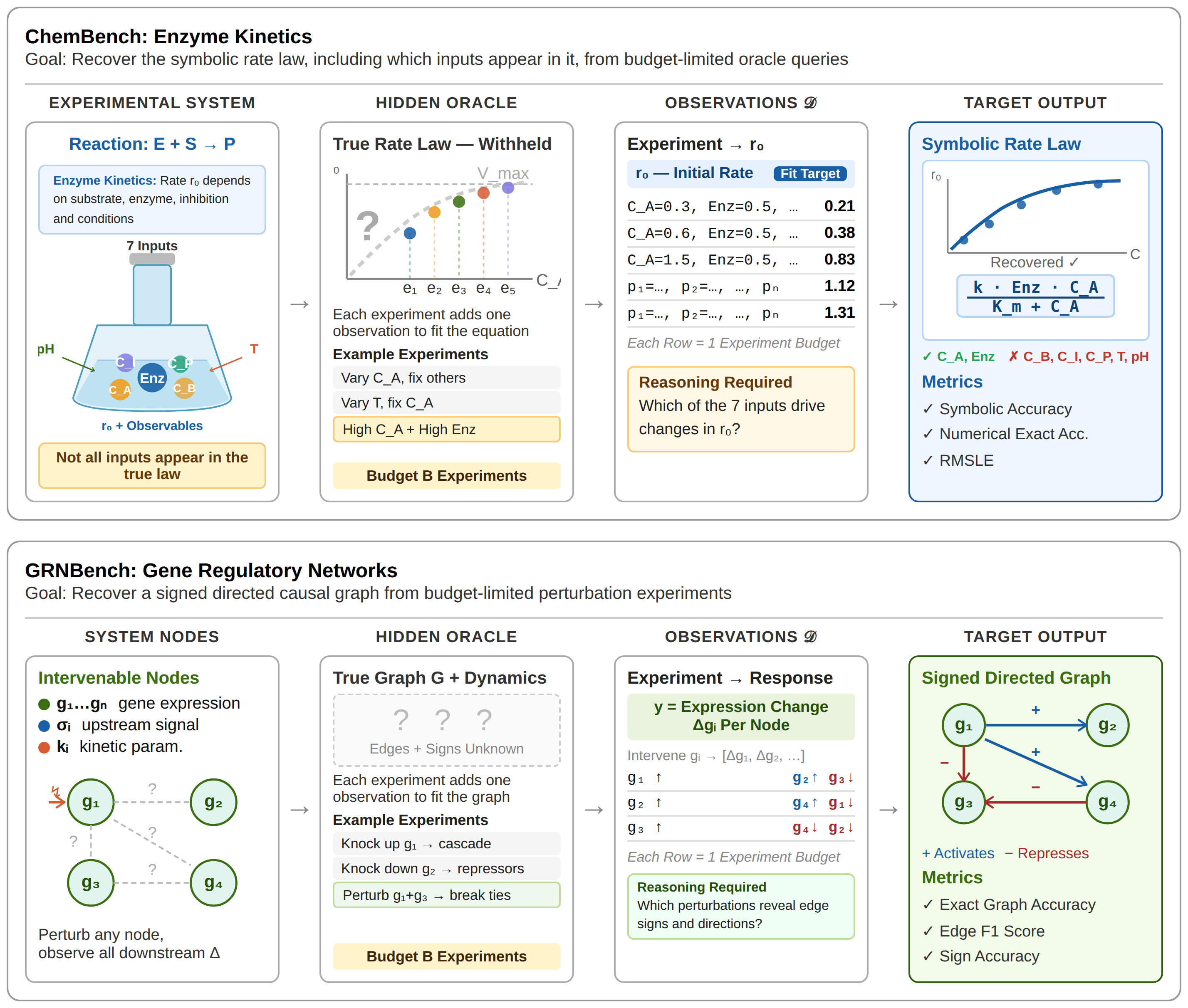
A new benchmark suite for active, budget-constrained scientific discovery where the learner must jointly design experiments, identify relevant variables, and recover true mechanisms.
Figure 2. Overview of ActiveSciBench. (a) ActiveSciBench-Chem: symbolic enzyme rate law recovery with distractor variables and budget-limited oracle access. (b) ActiveSciBench-GRN: signed directed gene regulatory graph inference from perturbation-response experiments.
Symbolic equation recovery across 11 physics domains including gravity, magnetic force, Fourier's law, Snell's law, radioactive decay, and harmonic oscillators. Uses counterfactual, memorization-resistant law variants with interactive oracle probing.
Enzyme kinetics rate law discovery across 57 domains covering Michaelis-Menten kinetics, competitive inhibition, substrate inhibition, Arrhenius temperature dependence, pH effects, and bisubstrate catalysis. Designed with distractor variables and anti-alignment to defeat classical Bayesian optimization.
Signed causal gene regulatory graph inference across 45 tasks. The learner must jointly identify topology, sign, and effective dynamics from sparse perturbation-response data. Motifs span feedforward loops, feedback, toggle circuits, and repression chains.
ActiveSciBench is the first suite requiring active exploration, interventional design, physical grounding, variable selection, and memorization-free evaluation simultaneously.
| Benchmark | Active Exploration | Interventional | Physical Grounding | Variable Selection | Memorization-Free | Discovery Target |
|---|---|---|---|---|---|---|
| Passive law benchmarks | ✗ | ✗ | ✓ | ✗ | ✗ | Closed-form law |
| LLM equation benchmarks | ✗ | ✗ | ✗ | ✗ | ✓ | Out-of-distribution |
| NewtonBench | ✓ | ✗ | ✗ | ✗ | ✓ | Counterfactual law |
| Optimization benchmarks | ✓ | ✓ | ✓ | ✗ | ✓ | Condition optimization |
| GRN inference benchmarks | ✗ | ✓ | ✓ | ✗ | ✓ | GRN inference |
| ActiveSciBench (Ours) | ✓ | ✓ | ✓ | ✓ | ✓ | Active mechanism discovery |
LLM-AutoSciLab outperforms all baselines across three benchmarks, achieving state-of-the-art symbolic accuracy and graph recovery with substantially fewer experiments.
SA = Symbolic Accuracy (%), Ex. = Exact Accuracy (%), RMSLE = Root Mean Squared Log Error. Budget B=20. Overall across Easy/Medium/Hard difficulty levels.
| Method | ED | SA↑ | Ex.↑ | RMSLE↓ |
|---|---|---|---|---|
| PySR | ✗ | 24.07 | 74.54 | 0.182 |
| Bayesian Opt. | ✓ | 24.54 | 68.52 | 0.334 |
| Bayesian Exp. Design | ✓ | 11.11 | 63.86 | 0.577 |
| LLM-only | ✓ | 6.48 | 7.41 | 5.039 |
| Code-assisted LLM | ✓ | 7.41 | 10.19 | 4.912 |
| LLM-AutoSciLab (Ours) | ✓ | 67.60 | 81.50 | 0.150 |
SA = Symbolic Accuracy (%), Ex. = Exact Accuracy (%), RMSLE = Root Mean Squared Log Error. Budget B=60. Overall across Simple/Composite domains.
| Method | ED | SA↑ | Ex.↑ | RMSLE↓ |
|---|---|---|---|---|
| PySR | ✗ | 7.89 | 15.79 | 1.212 |
| Bayesian Opt. | ✓ | 5.26 | 6.98 | 1.960 |
| Bayesian Exp. Design | ✓ | 31.58 | 39.47 | 0.249 |
| LLM-only | ✓ | 0.00 | 0.00 | 0.764 |
| Code-assisted LLM | ✓ | 0.00 | 0.00 | 0.824 |
| LLM-AutoSciLab (Ours) | ✓ | 35.09 | 50.88 | 0.189 |
F1 = Edge F1 (%), Ex. = Exact Graph Accuracy (%), Sign = Sign Accuracy (%). Budget B=20. Overall across Easy/Medium/Hard difficulty levels.
| Method | ED | F1↑ | Ex.↑ | Sign↑ |
|---|---|---|---|---|
| GENIE3 | ✗ | 38.60 | 0.00 | 79.07 |
| GIES | ✗ | 56.27 | 6.67 | 85.78 |
| NOTEARS | ✗ | 27.60 | 2.22 | 58.15 |
| Random + GraphFit | ✓ | 35.56 | 2.22 | 84.44 |
| Uncertainty + GraphFit | ✓ | 50.10 | 4.44 | 88.15 |
| LLM-only | ✓ | 50.41 | 0.00 | 79.44 |
| Code-assisted LLM | ✓ | 54.67 | 0.00 | 85.98 |
| LLM-AutoSciLab (Ours) | ✓ | 72.49 | 31.11 | 98.15 |
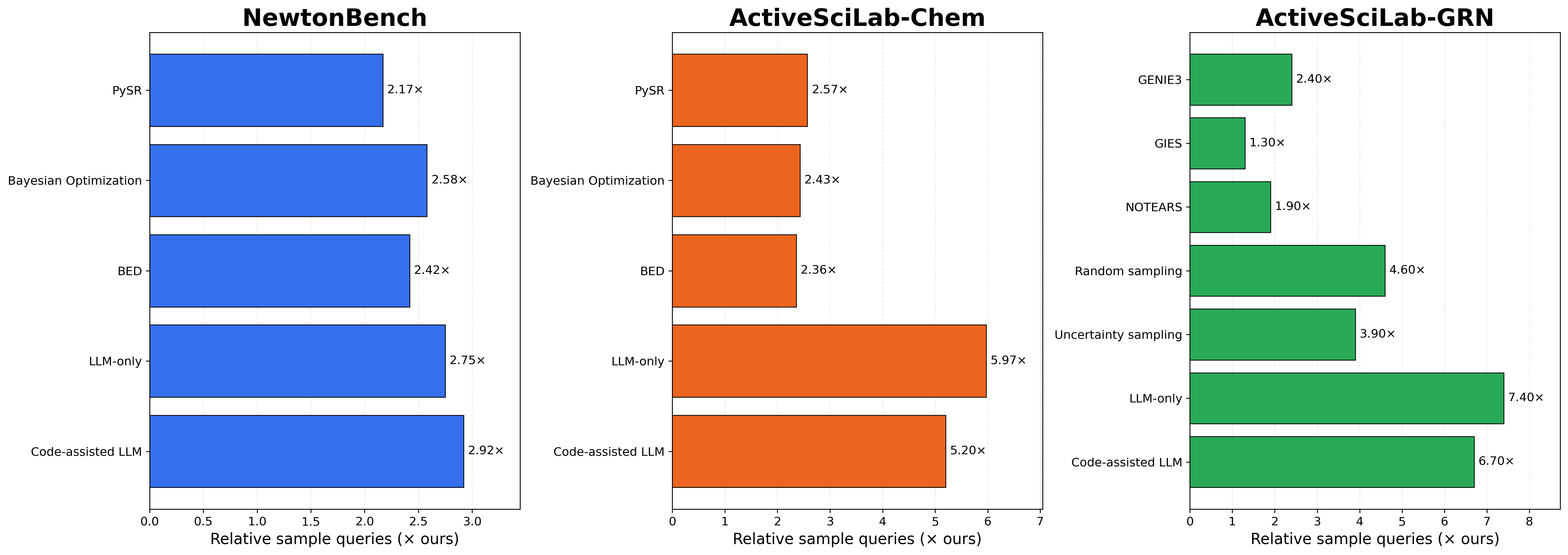
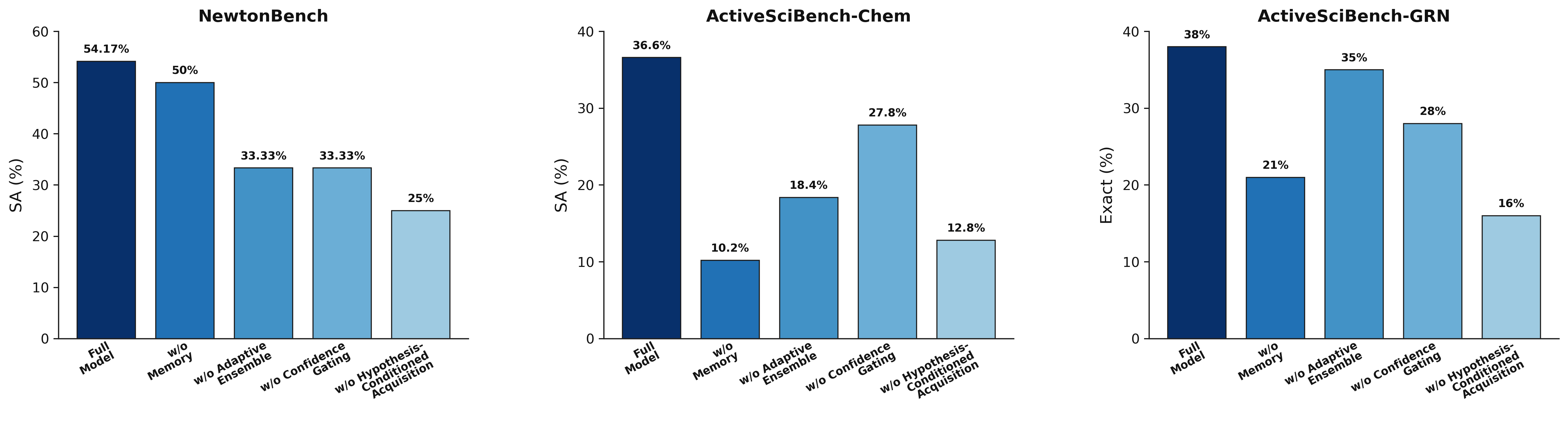
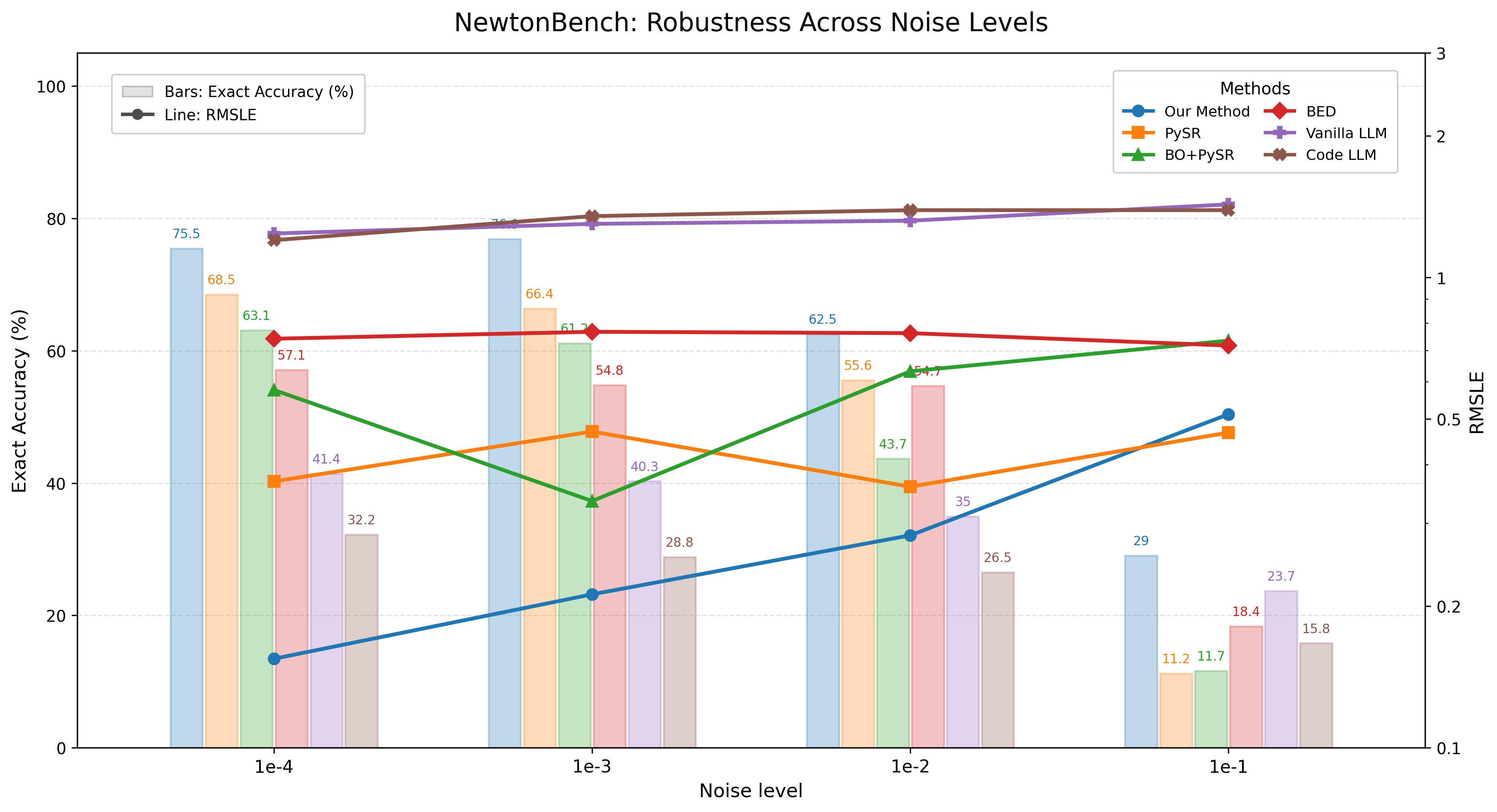
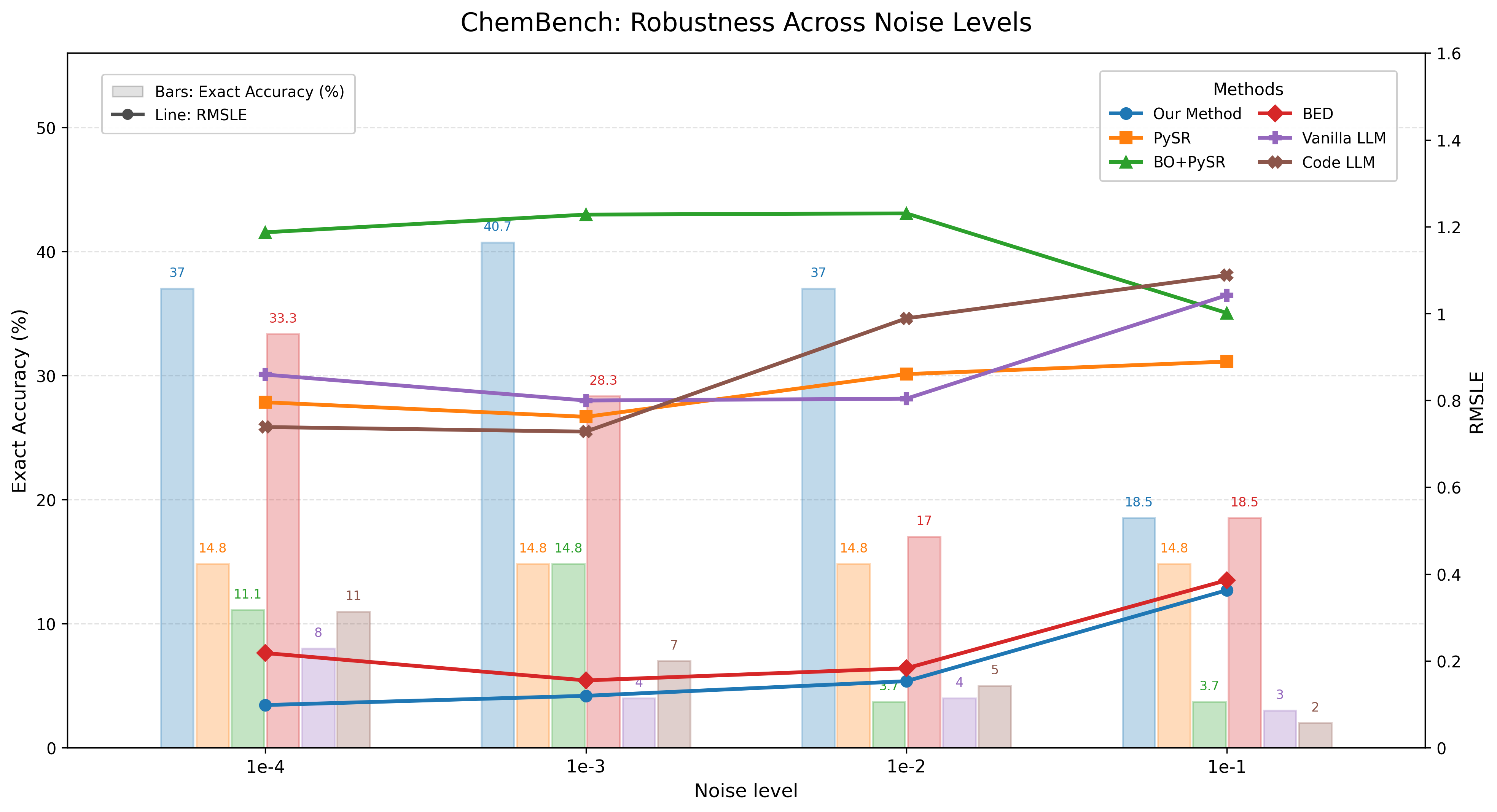
Sample efficiency curves, ablation studies, and noise robustness experiments confirm the contribution of each component.
Hypothesis-guided experimentation is 2–5× more sample-efficient than the strongest competing baselines, reaching equivalent performance with a fraction of the oracle calls.
Removing hypothesis-conditioned acquisition, the bootstrap confidence gate, or memory each leads to a significant performance drop, confirming the necessity of each component.
NewtonBench
ActiveSciBench-Chem
ActiveSciBench-GRN
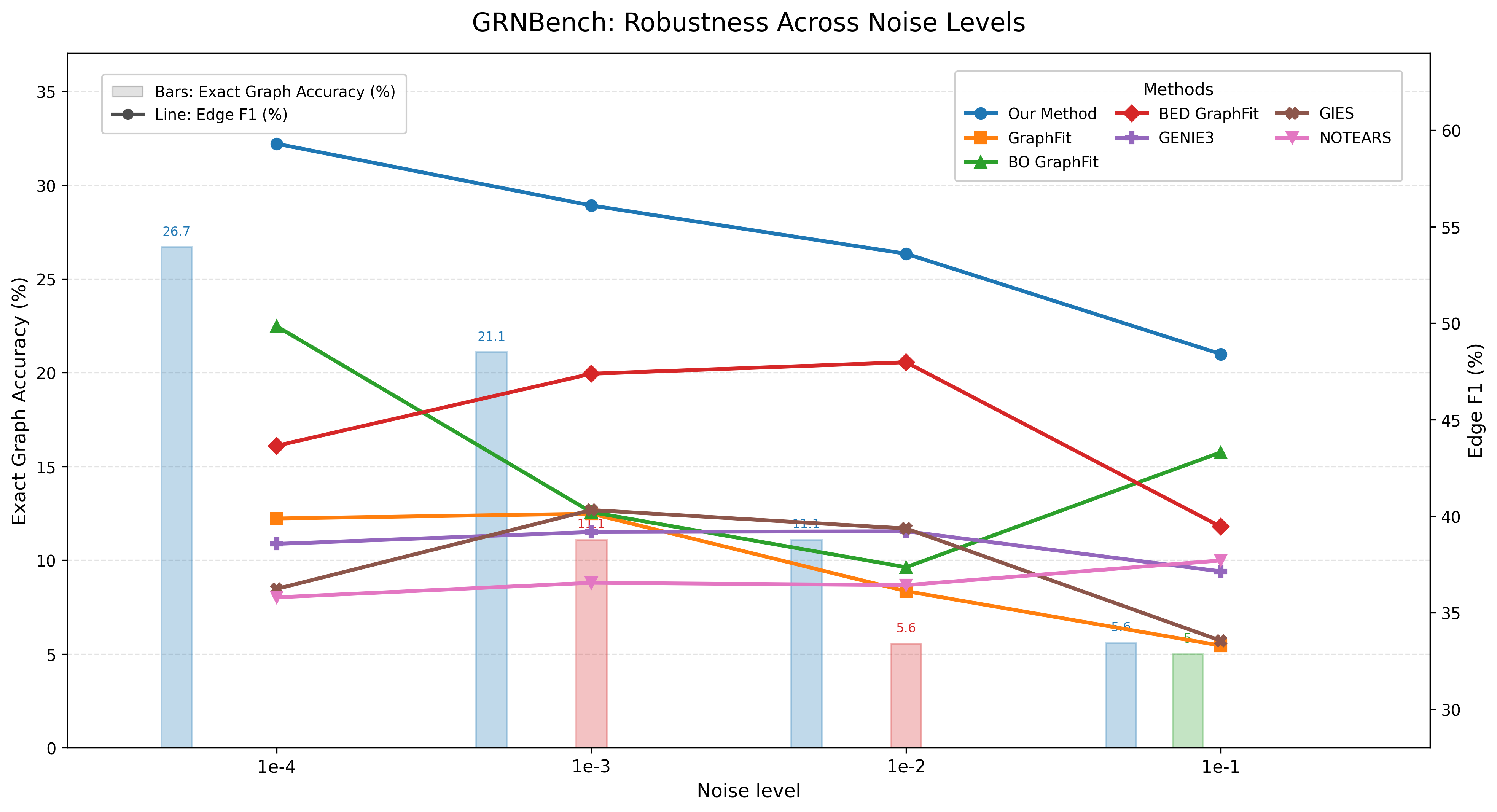
LLM-AutoSciLab remains robust under increasing oracle noise, substantially outperforming baselines even at high noise levels.
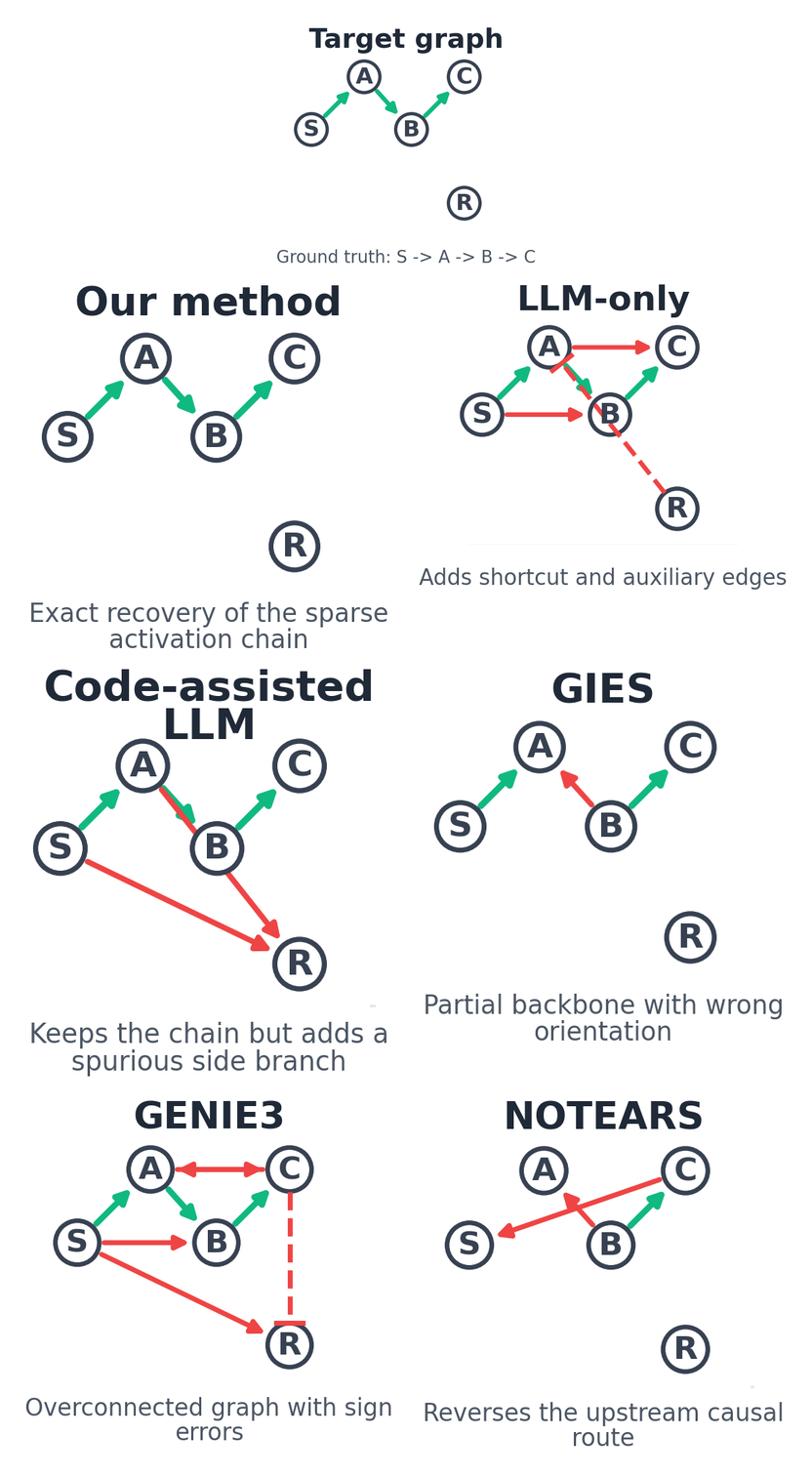
A qualitative case study on an activation chain GRN motif, showing how LLM-AutoSciLab progressively refines its hypothesis towards the correct signed causal graph across budget iterations.